
REGISTERED SOCIAL WORKER · KINCARDINE + VIRTUAL ONTARIO
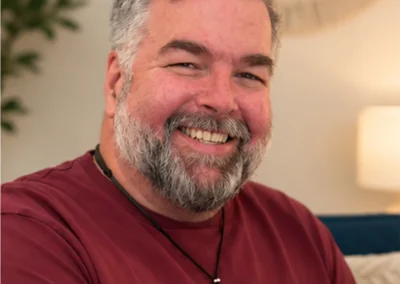
Stephen Hendriks
BSW, MSW, Registered Social Worker, Psychotherapist
You don’t have to be good at talking about feelings before you come to therapy.
I work with adults, teens, couples and families who want to better understand what is happening underneath stress, conflict, disconnection, substance use or patterns that keep repeating.
I’m especially drawn to working with men who want more emotional awareness without feeling like they have to become someone they’re not. Many of us were taught — directly or indirectly — to stay capable, keep moving, solve the problem and keep certain emotions to ourselves. Therapy can offer a different place to practise.
With more than 30 years of experience, my style is warm, relational and grounded. There is room here for humour, discomfort, emotion, uncertainty and the things that can be hard to put into words.
Not sure who might be the right fit? Start Therapy →
Adults · Teens · Couples · Families · In-Person Kincardine · Virtual Ontario
Rate: $165/hour Individuals, $195/hour Couples & Families

YOU MAY CONNECT WITH MY APPROACH IF…
You’ve spent a long time handling things — but not always talking about them.
- You want to become more comfortable identifying and expressing what you feel
- You’re a man who learned early to be strong, capable, independent or emotionally contained
- Anger, shutting down, withdrawing or getting defensive tends to show up before you know what you’re actually feeling
- You and your partner care about each other but keep missing one another emotionally
- Conflict turns into distance, escalation, silence or the same argument in a different form
- Alcohol, substances or other coping strategies have started to create problems
- Relationships feel complicated, intense or hard to repair
- You grew up in a rural or close-knit community where privacy, reputation and “dealing with it yourself” matter
- You’re going through a major life, work or identity transition
- You want therapy that is emotionally real without feeling overly clinical or performative
- You’re supporting a teen or family member through something difficult
- You’ve been carrying a lot for a long time and are beginning to wonder what it has cost you
WHAT THERAPY WITH ME IS LIKE
Warm enough to go there. Grounded enough to stay with it.
I’m comfortable talking about feelings — including the ones people often avoid, minimize or don’t quite know how to name yet.
That doesn’t mean therapy has to feel heavy all the time.
My style is warm, conversational and relational. I’ll listen carefully, ask questions, notice patterns and sometimes help slow things down enough that we can understand what is really happening underneath the argument, the shutdown, the anxiety or the urge to escape.
For many men, emotional awareness can feel unfamiliar because it wasn’t something they were taught or encouraged to practise. I don’t see that as a flaw. It often makes sense in the context of family, culture, work, masculinity and the messages boys receive about what they are supposed to do with vulnerability.
Therapy can become a place to develop more emotional range without losing the parts of yourself you value — strength, independence, responsibility, humour or competence.
And in relationships, that can make a real difference.
AREAS WE CAN EXPLORE TOGETHER
Men + Emotional Awareness
For men who want to understand what they feel, communicate more openly or feel less disconnected from themselves and the people they care about.
The work may involve anger, vulnerability, self-worth, fatherhood, masculinity, relationship patterns, stress or simply learning to notice emotions before they come out sideways.
Couples + Disconnection
When you still care about one another, but closeness has become harder to access.
Therapy can help slow down recurring cycles of criticism, withdrawal, defensiveness, resentment or emotional distance so each person can better understand what happens between you.
Addictions + Coping
When alcohol, substances or other coping strategies have become harder to manage or are affecting relationships, work, health or self-respect.
Stephen brings both addictions experience and Motivational Interviewing training to this work.
Rural Life + Mental Health
Living in a rural or close-knit community can bring strengths — connection, responsibility, identity, belonging — and its own pressures.
Privacy can feel harder to protect. Asking for help may feel unfamiliar. Roles can be deeply established.
Stephen understands the complexity of rural life and works with respect for the realities of small communities.
Complex Relationships + Family Dynamics
When relationships carry old hurt, loyalty, conflict, responsibility or patterns that are difficult to untangle.
This may involve partners, parents, adult children, blended families, caregiving or longstanding family dynamics.
Anxiety, Trauma + Life Transitions
When worry, panic, past experiences, work stress, identity shifts or major life changes make it harder to feel grounded.
HOW I WORK
Life can get messy. I offer clarity and a way to get through tough times.
After more than 30 years in mental health, I’ve learned that good therapy usually requires more than one way of looking at a problem.
Sometimes people need practical strategies, help understanding a pattern they’ve been repeating for years, or a relationship where they can finally say something out loud without immediately having to fix it.
I draw from approaches including Cognitive Behavioural Therapy, Emotion-Focused Therapy, Motivational Interviewing, Collaborative Problem Solving and attachment-informed work depending on the person, couple or family in front of me.
Relational work
Understanding what happens between people — especially during conflict, closeness and disconnection.
Emotional awareness
Learning to recognize emotions earlier and understand what they may be communicating.
Practical strategies
Developing skills that can actually be used outside the therapy room.
Motivation + change
Exploring ambivalence and helping change feel chosen rather than forced.
The approach matters. But so does having a therapist you can actually talk to.
ABOUT STEPHEN
Three decades of experience — and my work with clients has been the most meaningful part.
Stephen has spent more than 30 years working in mental health across community services, youth justice, intensive family treatment and psychotherapy. That experience has brought him alongside teenagers, adults, couples and families dealing with everything from current stress to much more complex mental health and relationship concerns.
Over time, his work has made him increasingly interested in what happens when people feel safe enough to become more emotionally honest — particularly people who were not raised with much language for emotion.
Stephen has a particular interest in working with men. He understands that boys and men often receive powerful messages about independence, toughness, competence and what emotions are acceptable to show. Those messages can be useful in some contexts and costly in others.
Rather than treating emotional guardedness as a problem to eliminate, Stephen is interested in understanding how it developed and helping clients expand the ways they can relate to themselves and the people around them.
He also brings a deep appreciation for rural and close-knit communities. He understands the strengths that can come from belonging, responsibility and longstanding relationships — as well as the complexities of privacy, reputation and asking for help when everyone seems to know everyone. His existing page already identifies rural and close-knit community work as an important part of his perspective.
Clients often experience Stephen as warm, emotionally present and easy to talk to. He is comfortable with complexity, but he does not believe therapy needs to feel complicated.

Trainings
• Unified Protocol (Trainer level)
• Motivational Interviewing (Trainer level)
• Dyadic Developmental Psychotherapy Level 1
• InterRAI Psychosocial Assessment Tool (Trainer level)
• Child and Adolescent Needs and Strengths Scale (CANS) (Trainer level)
• Comprehensive Treatment Planning and Documentation
• Addictions Certificate (in progress)
Areas of focus
- Childhood, developmental, and adult trauma
- Attachment wounds and relationship difficulties
- Anxiety (including worry, panic, and obsessive thinking)
- Difficulty managing emotions or feeling overwhelmed by emotions
- Early signs of psychosis and other serious mental health concerns
- Substance use concerns, including when they occur alongside mental health challenges
- Family therapy and support for parents and caregivers
- Support with safety concerns and developing safety plans
- Careful assessment to better understand symptoms and what may be contributing to them
- Holistic assessment that looks at emotional, psychological, social, and life factors


Psychotherapy
Contact
(226) 396-2200
hello@attunedtherapy.ca
1802 Highway 21, Kincardine ON N2Z2X4