
Key Takeaways
- Community is vital for mental health and healing, as it provides support and connection during life's challenges.
- Many people feel lonely in our individualistic society, leading to emotional distress at every age.
- Healing often occurs in relationships, where shared pain and comfort play a crucial role.
- Building community requires vulnerability and effort, but it helps foster resilience and belonging.
- Choosing connection over isolation can significantly improve our mental wellbeing and overall quality of life.
Estimated reading time: 10 minutes
Table of Contents
The Importance of Community for Mental Health and Healing
By Nicole Walker, Registered Psychotherapist
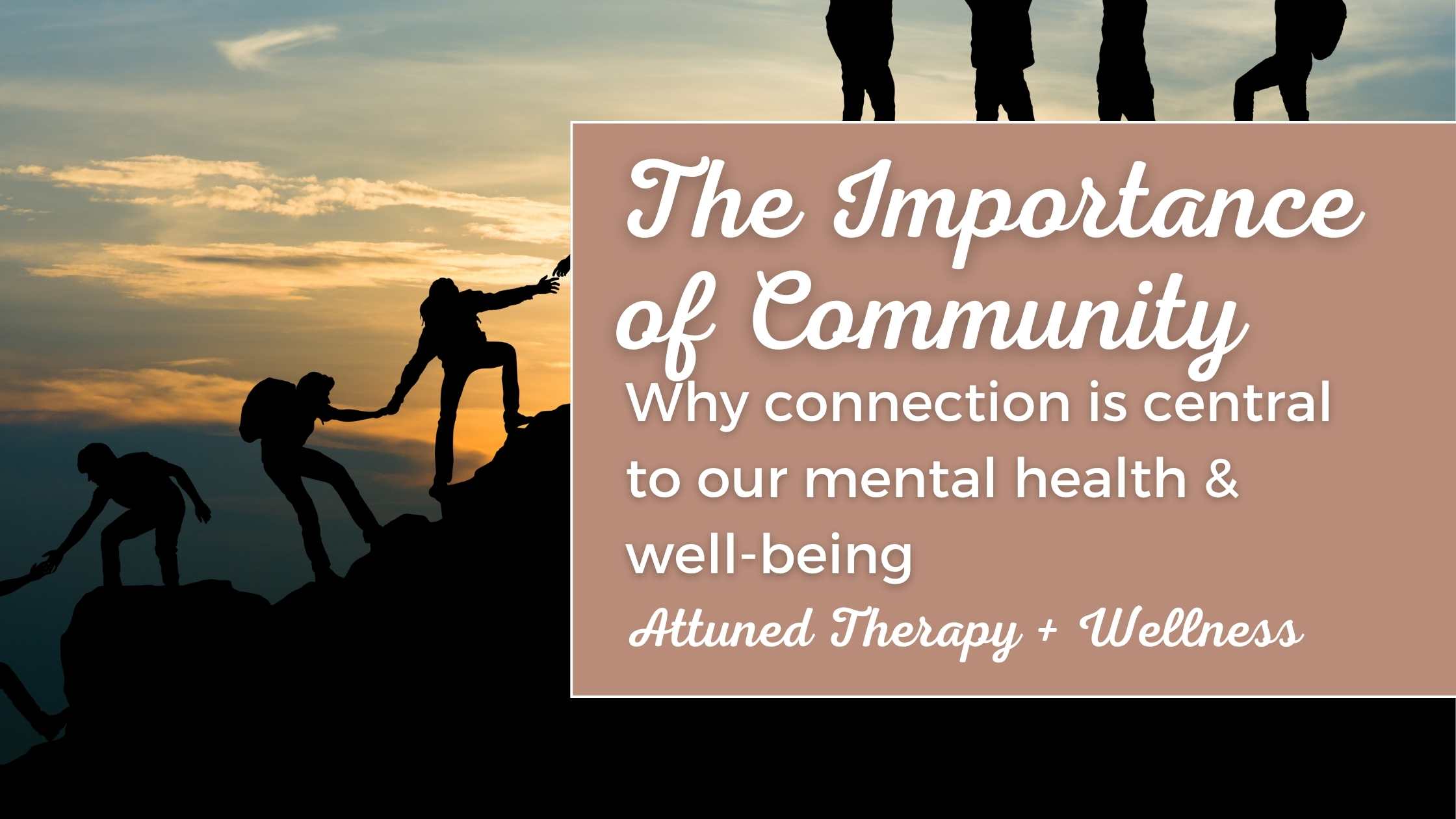
Community plays a vital role in our mental health, emotional wellbeing, and ability to heal from life's challenges. While many of us have been taught to value independence above all else, our nervous systems are wired for connection. Healing often happens not in isolation, but in the presence of safe, supportive relationships. Whether through family, friends, or trauma-informed therapy, meaningful relationships remind us that we were never meant to navigate life alone.
We Were Never Meant to Do Life Alone
What if what was missing wasn’t the answer to all our problems, or a solution for our pain, but what if the missing piece was a community within which we found help to endure the inevitable ups and downs of life? What if we didn’t need an ‘out’? What if we needed someone to join us on the inside?
We Care for Ourselves by Tending to Our Connections
One of the most common phrases to exit my mouth while in the therapeutic space is a reassurance and encouragement that we were never intended to experience life alone. We were created as relational beings, meant to live in community and experience the trials and tribulations of life amidst the comfort of helpful hands, safe witnesses, and teammates.
It's a design so fundamental to human nature that we rarely think to question it—the way we don't think to question our need for air, water, or sleep. And yet, we've built an entire culture that asks us to do exactly that: to override the design, to prove we don't need what we were made for.
While I don’t know what gave birth to our individualistic culture, I do know just how destructive it has been for so many. The consequences of a lack of connection and the absence of community are showing up all around us.
We've been sold independence as the ultimate goal—self-sufficiency as strength, needing no one as a badge of honour—and in the process, we've mistaken isolation for freedom.
But freedom was never supposed to cost us each other.
The lack of connection and the absence of community are showing up all around us, and it isn't working. We can see the fallout everywhere we look, if we're willing to look.
Research consistently shows that social connection plays an essential role in both physical and mental health. Humans are biologically wired for connection, making supportive relationships a necessity rather than a luxury.
The Loneliness We Carry in Our Individualist Society
We see it in kids who are more comfortable behind a screen than in a room full of people.
We see it in teens navigating high school comparison, quietly believing they have to handle everything on their own.
We see it in new parents, especially moms, turning to TikTok for reassurance that used to come from a mother or a friend down the street.
We see it in twenty-somethings starting over in new cities without a single name to call when things get hard.
We see it in men who were taught that needing people is a weakness.
And we see it in our elderly, who understand better than anyone what it means to miss each other.
We are lonely—at every age, in every season, just in different ways.
We are lonely—at every age, in every season, in ways that look different but ache the same.
And more than that, we are lonely in a way our bodies and minds were never built to withstand.
This isn't a new discovery or a passing trend. Every generation before ours, in every corner of the world, has understood that we survive together or not at all.
What we are doing right now isn't working.
We must rescue our relationships.
We must tend to our connections.
Loneliness doesn't simply affect how we feel emotionally. Research suggests that chronic social isolation is associated with increased stress, poorer physical health, and a greater risk of anxiety and depression. Our relationships are one of the greatest protective factors we have for our wellbeing.
Sitting in Our Grief and Suffering Together Offers Healing
Grief is tender. Does it need to be fixed, or does it simply need comfort?
Community doesn't need to be as complicated as we perceive it to be.
I think it’s important to remind ourselves that the healing and the energy we seek and benefit from in community are not limited to those who have the training or the credentials to "fix" us.
Our grief and our pain can find comfort not only in the shared space of a therapist's office or a pastor's counsel, but also sitting cross-legged on a friend's couch, being allowed to simply take up emotional space.
Finding a friend who will sit and listen.
Visiting the sister who will cry as we cry.
Comfort doesn't always announce itself with a solution—sometimes it just shows up and stays.
The power of community is in the being, not the doing.
Being with others who have known our particular flavour of pain, or who are simply willing to sit with us in the dark spaces of our hurt without trying to drag us out of them before we're ready.
Healing through connection often begins when someone is willing to sit beside us rather than trying to fix us. Feeling seen, heard, and accepted creates the safety our nervous systems often need before deeper healing can occur.
Comforting Our Shared Pain in Togetherness
Our pain doesn't always require a solution.
Our pain requires comfort.
And the greatest part about all of this is that we have the opportunity to find this kind of comfort all around us.
A walk with our partner at the end of a taxing day.
Cozy tea with a trusted friend.
Laughter with a stranger in the café line that catches us off guard and reminds us we're still capable of lightness.
Perhaps there’s nothing more soothing for a broken heart than a healed heart with the scars to remind us we can survive it too.
I think sometimes what we are missing is the opportunity to be seen while we are still becoming: becoming healed, becoming more aligned and attuned within ourselves, becoming the best versions of ourselves, becoming who we didn’t know we could be.
To be seen in the process.
To be seen by those who have maybe also shared in the process.
Emotional support doesn't always come through advice. More often, it comes through presence. The simple act of being with another person in moments of joy or suffering reminds us that we don't have to carry life's burdens alone.
What if what was missing wasn’t the answer to all our problems, or a solution for our pain but what if the missing piece was a community within which we found help to endure the inevitable ups and downs of life. What if we didn’t need an ‘out’ what if we needed someone to join us on the inside.
In Order to Have Community, We Have to Be Community
You've heard it before, and it's painfully true every time: the most valuable things in life are the things that cost us effort, time, and care.
Building community requires vulnerability.
It requires sacrifice.
It requires a level of discomfort we'd rather avoid.
And it's important to remember—discomfort is not bad.
It's necessary.
It's the toll we pay for something worth having.
Community doesn't appear fully formed, waiting for us somewhere. Instead, it grows through intentional choices, small acts of courage, and a willingness to be seen. Healthy relationships are built over time, often through ordinary moments of showing up for one another.
The reality is this: we don't find community fully formed, waiting for us somewhere.
We build it, piece by unglamorous piece.
We have to abandon our pride and ask a friend for help.
We have to be the one to reach out first, to host the dinner even when the house isn't clean, to show up for someone else's hard day so that ours will be shown up for too.
We have to risk being inconvenient to people and let them risk being inconvenient to us—because that's what it actually looks like to be known.
Community isn't a thing that happens to us.
It's a practice.
It's showing up consistently even when it's easier not to.
It's choosing the harder, slower work of real relationship over the sanitized ease of isolation.
It's letting someone see us before we've cleaned ourselves up.
And slowly, unremarkably, that's how it's built—not in one grand gesture, but in a hundred small ones, repeated until one day we look around and realize:
This is what having people feels like.
Healing Happens in Relationship
While therapy can be an incredibly meaningful place to begin healing, it is rarely meant to be the only place where healing occurs.
The therapy room offers something incredibly important: safety, attunement, and a space to begin understanding ourselves. But healing often continues beyond those walls—in conversations with trusted friends, quiet moments with family, shared laughter around a dinner table, or someone simply sitting beside us when words aren't enough.
Connection doesn't erase pain.
It helps us carry it.
Being witnessed in our suffering reminds us that we are still worthy of love, belonging, and care, even when life feels unbearably heavy.
Perhaps healing isn't about becoming someone entirely different.
Perhaps it's about remembering that we were never meant to carry life by ourselves.
We Were Never Meant to Do Life Alone
If there is one thing I hope you take away from this, it is this:
We were never meant to do life alone.
Not our grief.
Not our joy.
Not our healing.
Not our becoming.
In a culture that celebrates independence, choosing connection can feel vulnerable.
It can feel inconvenient.
It can even feel frightening.
But perhaps that vulnerability is exactly where healing begins.
Community isn't simply something that benefits our mental health.
It is part of what allows us to flourish.
The people who sit beside us in our suffering don't take our pain away.
They remind us we don't have to carry it alone.
So maybe what we've been searching for wasn't an escape from hardship.
Maybe it was each other.
We were never meant to do this alone. So let's stop pretending we can.
You Don't Have to Heal Alone
At Attuned Therapy + Wellness, we believe healing happens in the context of safe, attuned relationships.

Whether you're navigating trauma, anxiety, grief, parenting challenges, or simply feeling disconnected, our therapists are here to walk alongside you—not to "fix" you, but to help you reconnect with yourself and others in meaningful ways.
Healing isn't about having all the answers.
Sometimes it's about finally having someone beside you while you discover them.
If you're ready to begin your healing journey, we're here to support you. We provide psychotherapy to individuals, families and couples seeking safe, attuned, connected counselling. We offer free 15 minute consultations on our booking platform to offer space for you to speak to someone on our team before booking your first therapy session.

0 Comments